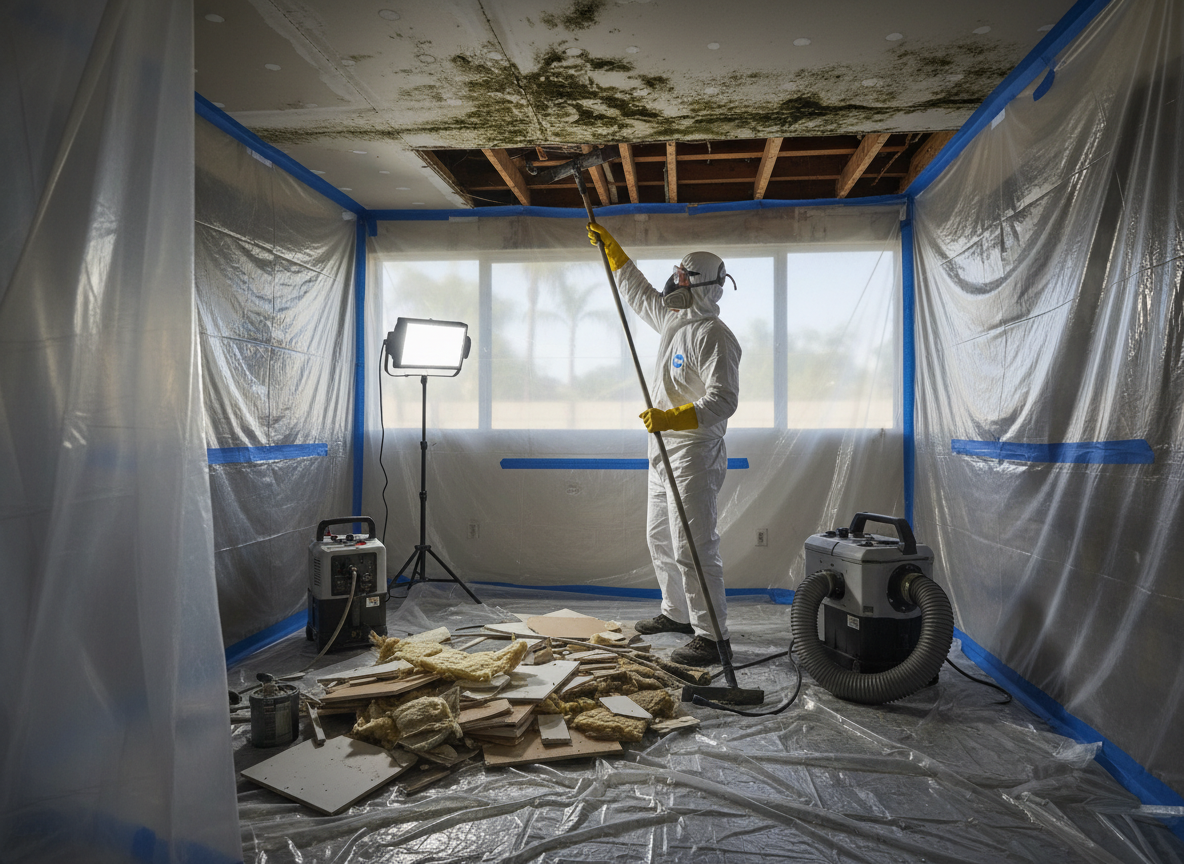
Northridge homes built before the 1980s often feature stucco exteriors and slab foundations that trap moisture when summer temperatures spike above 90 degrees. Hot, dry days alternate with occasional heavy rains that send water along Reseda Boulevard corridors into crawl spaces and around window frames in Northridge East and Northridge West. Abatement crews must separate affected drywall and insulation without disturbing settled spores that travel easily through single-story ranch layouts common near California State University Northridge.
Los Angeles County building codes require negative-air containment and HEPA filtration whenever visible mold exceeds ten square feet. In properties near the Northridge Fashion Center or along Nordhoff Street, technicians frequently encounter mold growth behind textured ceilings where roof leaks from summer storms have gone unnoticed. Removing the material means cutting back to sound substrate, treating adjacent wood framing with EPA-registered antimicrobials, and documenting moisture levels before any reconstruction begins.
Nearby neighborhoods such as Chatsworth, Granada Hills, and Porter Ranch share similar tract-home construction, yet Northridge’s slightly higher water table near the old wash areas creates extra edge cases. Abatement teams routinely pull carpet pads and baseboards in these zones because capillary action pulls humidity upward even after the initial leak is fixed. Post-remediation clearance testing confirms spore counts have returned to outdoor baseline levels before occupants return.
Owners along Reseda Boulevard sometimes attempt bleach cleaning on porous surfaces, which leaves roots intact and allows regrowth within weeks once humidity climbs again. Professional abatement uses physical removal followed by source control, such as improving attic ventilation in the hot months, to keep the same wall cavities from recurring problems.
Technician insight
In Northridge, the thing that catches most people out with mold abatement is the way hot summer afternoons pull residual moisture from the soil up into older slab foundations along Nordhoff Way and in Northridge West; homeowners keep treating the visible wall but miss the constant humidity source under the carpet until we pull the pad and show them the elevated readings.
Hidden Growth Behind Kitchen Cabinets
A Northridge East homeowner noticed a musty smell after a July heat wave. Inspection found elevated moisture behind the sink base where an old supply line had sweated into the particleboard. We removed the lower cabinets, cut out two feet of drywall, treated the framing, and dried the cavity for three days. Clearance samples passed and the owners reinstalled new cabinets without further odor.
How it works
- 1
Initial Assessment
Technicians arrive within hours, map moisture with infrared and pin meters, and identify all affected materials in the specific Northridge structure.
- 2
Containment Setup
Plastic barriers and negative-air machines isolate the work zone to prevent cross-contamination into unaffected rooms or neighboring units.
- 3
Physical Removal
Moldy drywall, insulation, and trim are cut out and bagged for disposal while surfaces are HEPA-vacuumed and treated.
- 4
Drying and Clearance
Dehumidifiers and air movers bring moisture content below 15 percent, followed by independent air sampling before barriers come down.
Pricing
Cost depends on square footage affected, accessibility, and whether hidden cavities behind stucco or slab edges require additional demolition.